

A Guide to Avoiding Major Blocked Drains
If you own a house or manage a business in Bedfordshire, Hertfordshire, or Buckinghamshire, you’ve probably seen lots of basic advice on preventative maintenance for drains. We won’t waste your time by simply repeating it. Instead, the Drainflow team will share what we’ve learned from over 20 years of clearing un-glamorous blockages across the region. You’ll get direct advice from drainage specialists who know exactly what travels through your local pipes.
Why Preventative Maintenance Changes Everything
Preventative maintenance means looking after your drains on your own schedule, rather than waiting for an emergency on a Sunday night. It involves a professional drain clearance team coming out to scour the inside of your pipes with high-pressure water and check their structural health with a digital camera.

It’s important because underground pipes are out of sight; so you won’t know they are failing until they overflow. Because Drainflow is a long-established drain clearance company, we won’t just show up to poke a rod down a hole; we know the local housing stock which means we can deliver the maintenance you need to keep your property safe.
The Chiltern Chalk Effect – How Hard Water Quietly Narrows Your Drains
You can’t see what happens inside your underground pipes, but if you live in Bedfordshire, Hertfordshire, or Buckinghamshire, your drainage system is dealing with a specific regional problem. Our local water flows through extensive chalk aquifers, which means that it’s full of minerals giving us our characteristically hard water. Over years of use, this hard water leaves a hard calcium carbonate crust along the inside walls of your waste pipes.
This limescale build-up narrows the diameter of your pipes. A standard four-inch clay or plastic pipe gradually narrows down to two or three inches. The impact this has is that the smooth interior becomes like rough sandpaper. So when you put hair, soap, or grease through your drainage system, it catches on this chalky scale instead of washing away cleanly.
Standard supermarket chemicals won’t dissolve this limestone crust; it needs professional mechanical descaling or targeted high-pressure water jetting to restore the pipe to its original size.
The Clay Pipe Problem in Beds, Bucks & Herts
If your property in Bedford, Hitchin, or Amersham was built before 1970, your underground drainage system installed is likely to be salt-glazed clay pipes. These pipes were laid in short sections and sealed together using cement or mortar. Over the last fifty or sixty years, that mortar has naturally cracked, shrunk, and washed away due to ground movement and constant water flow.
Once a drainage joint opens up even a fraction of a millimetre, it releases a small trail of moisture into the surrounding soil. Nearby trees and large shrubs find this moisture and follow it directly to the source. Hair-like roots force their way through the open joint and expand rapidly inside the pipe, feeding on the organic waste.
This is called root ingress (roots entering the pipe system). They create a dense, fibrous mat that acts like a net, catching toilet paper and solids. A plunger or shop-bought chemical won’t touch this; it requires mechanical root-cutting blades and a CCTV drain survey – using a remote-controlled waterproof camera – to see if the root-infested pipe is still structurally sound or if it has completely collapsed.
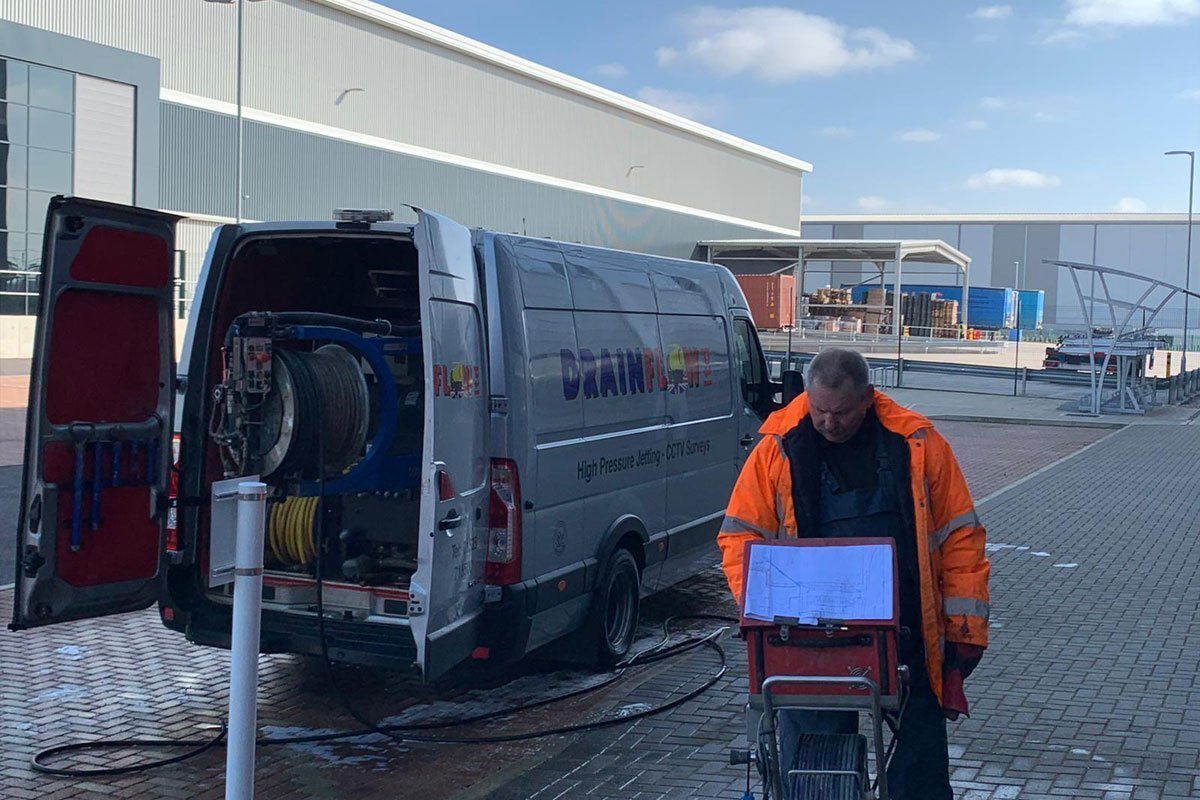
Why Proactive Drain Care Makes Practical Sense
The real cost of a badly blocked drain is rarely just the contractor’s invoice. For local businesses, a main drain backup can mean having to close for a period, losing stock, or pausing operations. For homeowners, it means disruption to your daily routine and potential damp or flooring damage.
Preventative maintenance removes that layer of unpredictability. By investing a small, controlled amount in a routine drainage flush, you essentially eliminate the risk of a severe block. It is the exact same logic as servicing your family car or your central heating boiler. You spend a little now to ensure you don’t have to spend significantly more later on emergency fixes and property clean-up.
Proactive vs. Reactive – How Our Specialist Tools Are Used for Maintenance
We use high-pressure water jetting and CCTV drain surveys differently when we are working on preventative maintenance.
Rotary Descaling (Not Just Clearing)
In an emergency, we use a basic clearance nozzle just to punch a quick hole through a blockage. For preventative maintenance, we switch to specialised rotary descaling heads that spin to scour the entire internal wall of the pipe, stripping out years of hard chalky limescale and solidified grease.
Proactive Mapping (Not Just Post-Damage Diagnosis)
Instead of using a CCTV camera to locate a pipe that has already collapsed, a maintenance survey maps your entire drainage network while it is clean. It inspects the structural health of every single mortar joint and sets a baseline for your system’s health.
Early Intervention
By combining thorough cleaning with a clear visual inspection, we catch minor flaws, hairline cracks, and fine root intrusions long before they turn into major, expensive structural failures.
Your Checklist for Preventative Drain Care
To protect your property from sudden blockages and emergency drain clearance fees, here is a checklist of what needs to happen to keep your drainage system proactively maintained:
Schedule a High-Pressure Jet Flush – If your property hasn’t had its drains flushed in the last two years, a routine water-jetting service will strip away the chalky limescale before it creates a rough bottleneck.
Book a CCTV Survey for Clay Pipes and Mapping – If your home or business premises was built before 1970, get a camera survey to check the health of your mortar joints and spot early tree root ingress.
Review Your Budget – Stop running your drainage system on a reactive basis. Switch to a planned maintenance schedule to guarantee a fixed, predictable rate during regular working hours.
Preventative Drain Care – FAQs
To help you, we’ve answered some of the most frequently asked questions about preventative drain maintenance.
For most properties in Beds, Herts, and Bucks, a high-pressure jetting service is recommended every 12 to 24 months. If your property has older clay pipes and a garden with mature trees, however, we would recommend an annual camera check in order to catch root growth before it fractures the pipes.
No. Over-the-counter chemical cleaners are designed to dissolve basic organic matter like hair and grease in the sink trap. They can’t dissolve the hard calcium carbonate deposits caused by local hard water, and they will have absolutely no effect on tree root systems growing inside underground clay pipes.
High-pressure water jetting uses specialised pumps and flexible hoses to blast water through your drainage system at very high speeds. It strips scale and debris off the pipe walls cleanly. When operated by an experienced drainage engineer who adjusts the pressure to suit the specific age and material of your pipes (such as older clay), it is perfectly safe and highly effective.
Early warning signs include slow-draining sinks, gurgling noises from your plug holes, or unpleasant smells coming from your drains. If you notice localised damp spots on your driveway or lawn, or if your ground-floor toilet water level rises higher than usual when flushed, these are clear indications that a partial blockage or structural joint failure is developing.
Get Advice You Can Rely On From Local Drainage Specialists
With over two decades of clearing pipes across Beds, Herts, and Bucks, the Drainflow team knows exactly what it takes to keep local systems working perfectly. Controlled, low-cost preventative maintenance protects your home or business premises long-term.
Get in touch with the Drainflow team now to book your preventative check – 01525 718500